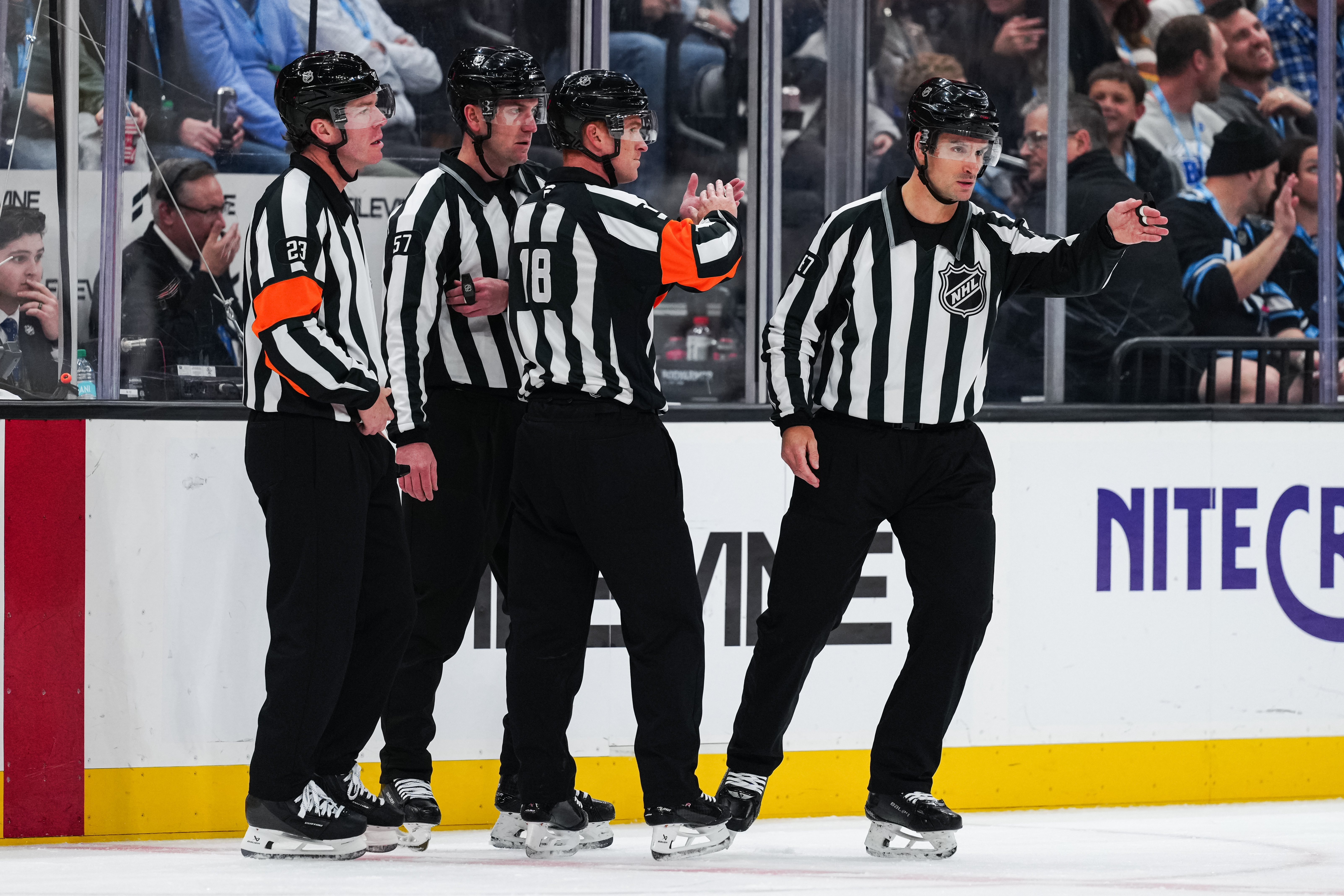
SALT LAKE CITY, UTAH - Referee Corey Syvret linesman Dylan Blujus #57, referee Tom Chmielewski and linesman Travis Gawryletz signal a faceoff after a review during the first period of the game between the Minnesota Wild and Utah Mammoth. (Photo by Eli Rehmer/NHLI via Getty Images) (Eli Rehmer via Getty Images) Sean Leahy Contributing writer Sat, November 14, 2026 at 8:22 PM UTC · 4 min read About Our Ads Advertisement Advertisement Advertisement The good news for the NHL is that officials for their 13 North America-based games on Saturday made it to their destinations without issue. Friday's ground stop order issued by the Federal Aviation Administration (FAA) has already impacted numerous college football games and forced reassignments of NFL and NBA officials this weekend.
But how would the NHL have reacted if any games were affected by the disruption in air travel?
There's a nearly-hundred year-old rule for that .
The NHL has long had rules in place should an official be unable to continue officiating a game due to injury, illness, accident, or "misadventure." Either the game would continue with one fewer official or a spare official would be called into duty, if available.
If circumstances prevent a referee or linesperson from being able to make it to the arena for a game, the NHL would "make every attempt to find suitable replacement officials."
And if that fails? That's where things get fun and interesting.
Rule 31.11 states that in that case one player would be chosen by each team to serve as the referee or linesperson for the game. The home team's choice would act as referee and visiting team's player would be a linesperson.
It's a wild situation to think about, but it's one that has happened in the NHL.
That exact scenario took place on Jan. 15, 1983 during a game between the Hartford Whalers and New Jersey Devils at the Hartford Civic Center. A snowstorm caused referee Ron Fournier and linesman Dan Marouelli to arrive late after the game got underway. While the teams waited, Whalers defenseman Mickey Volcan, who nursing a hand injury and wasn't going to play, and Devils forward Garry Howatt were chosen to work as linemen until the two officials made it to the rink in the second period.
Linesman Ron Foyt's attendance was not affected as he had flown in the night before. He worked as the referee until Fournier was ready to go.
"All of a sudden, [Whalers coach] Larry Kish said, 'We're going to have a player from each team and you're going to represent our team,'" Volcan told NHL.com in 2013. "So we put on some sweats and black practice jerseys and they called us in to the room prior to the game. We sat down and he [Foyt] went through it with us."
The NHL's executive vice president of officiating, Stephen Walkom, a former NHL ref himself, told The Athletic in March that he couldn't imagine a time when using players as officials — even with Rule 31.11 in place — was a realistic option for the league in order for a game to take place.
"Obviously we can assign who we think was capable of doing the game, but we never want to put our players in jeopardy and not put officials on the ice that we don't think are competent and qualified to work the hockey game," Walkom said. "Like I said, it's a rare thing, but I think at some point in time, in the NHL, through misadventure, weather, sickness, something, you must have had a time where GMs didn't agree on who to put on the ice because of officials not showing up and they had to put a remedy in place in the book to account for having the game covered."
Source: Sports
